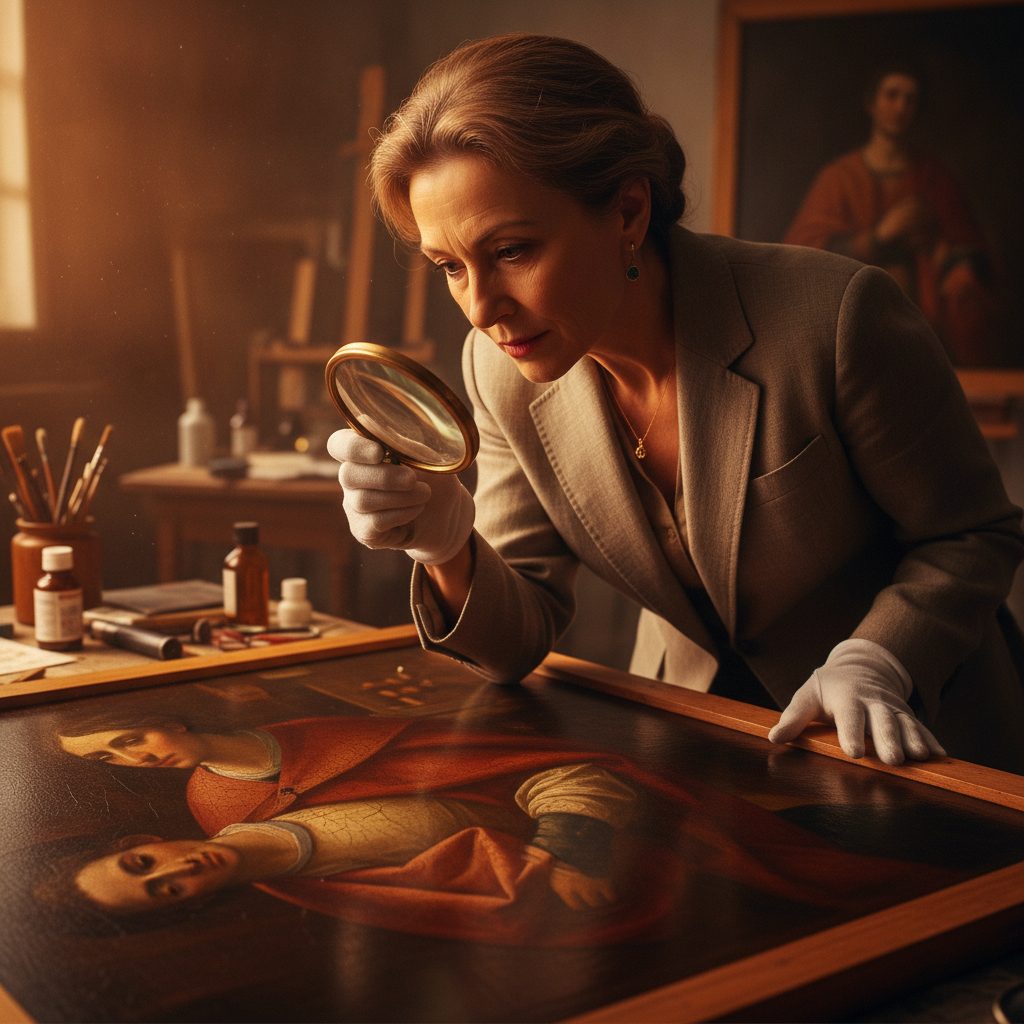
Most of us walk through a gallery at the pace of a supermarket, giving each painting the six seconds it takes to read the label. A masterpiece will not open up at that speed. It was built to be read slowly, in layers, the way its maker built it. The good news: the skill of slow looking is learnable, and it rests on five simple questions. Ask them in order and almost any great painting will start to speak.
1. Composition: how is your eye being steered?
Before subject or story, notice the architecture of the picture. Every masterpiece is a machine for guiding your gaze. Look for the underlying geometry — a stable triangle (as in most Renaissance Madonnas), a diagonal that creates movement and drama, a strong horizontal that brings calm. Find the focal point and ask how the artist gets you there: through converging lines, a pointing gesture, or the brightest patch of light. Notice, too, the empty passages; the quiet areas are what let the busy ones sing.
2. Light: where does it come from, and what does it touch?
Light is never accidental in a great painting. Trace its source and follow what it lands on — because that is what the artist wants you to feel is important. A single dramatic beam pulling a figure out of darkness (see chiaroscuro) creates tension and theatre; a soft, even light creates serenity and truth. The direction and quality of light set the entire emotional temperature before you have identified a single figure. The feathery touch of a painter like Berthe Morisot shows how the brushwork itself can carry that feeling.
A painting tells you what matters by what it chooses to illuminate.
3. Colour: what is the palette doing to you?
Colour works on the body before the mind. Warm reds and golds advance and excite; cool blues and greens recede and calm. Watch for deliberate contrast — a single stroke of vivid red in a field of muted brown will seize your attention, and the artist knew it. Historically, colour also signalled money and meaning: ultramarine, ground from imported lapis lazuli, once cost more than gold, which is why it was reserved for the robes of the Virgin. The palette is never just decoration; it is a coded set of priorities.
4. Gesture and expression: the human current
Now come to the figures — but read their bodies before their faces. A tilt of the head, a turned back, a hand caught mid-motion carries the story. The old masters studied anatomy and stagecraft precisely so a pose could speak. Ask what each figure is doing, where they are looking, and how they relate to one another. Often the true subject of a painting is not an event but a relationship — a glance exchanged, a touch withheld — held in the arrangement of limbs and eyes.
5. Symbolism: the layer beneath the surface
Older paintings speak a symbolic language their first viewers read fluently and we have mostly forgotten. A dog at a couple's feet meant fidelity; a skull or a snuffed candle was a memento mori, a reminder of death; a lily meant purity, a lemon meant bitterness beneath sweetness. You don't need to memorise a dictionary — but knowing that this layer exists changes how you look. When an odd object sits prominently in a scene, assume it was chosen on purpose, and let your curiosity (or the wall text) fill in the meaning.
Then — and only then — read the label
Notice the order. Do your own looking first; let the label land last. If you read the curator's note before you look, you spend the whole encounter hunting for what you were told to find, and the painting never gets to surprise you. Read it afterward and the context deepens what you already noticed — the date, the patron, the story behind the commission all sharpen a response you arrived at yourself.
This is the difference between glancing and reading. A masterpiece is not a locked box with one right answer; it is a rich text that rewards attention in proportion to the attention you give it. Spend five real minutes with one great painting — composition, light, colour, gesture, symbol — and you will leave the museum having seen something, rather than merely having been there.