For a few extraordinary decades around the year 1500, three men working in the same small corner of Italy pushed painting further than it had moved in the previous thousand years. They knew one another, competed with one another, and occasionally despised one another. Between them, Leonardo, Michelangelo and Raphael defined what "great art" would mean in the West for the next four hundred years — a standard so complete that later ages simply called their era the High Renaissance.
What made them different was not just talent. It was a new ambition: that a painting should not merely show a holy scene, but should hold real bodies in real space, lit by real light, moved by real feeling. Each of the three chased that goal down a different road.
Leonardo: the painter as scientist
Leonardo da Vinci (1452–1519) approached art as a form of research. He dissected corpses to understand how a shoulder moves, studied how light scatters in mist, and filled thousands of notebook pages with the mechanics of water, flight and the human face. All of it fed the brush.
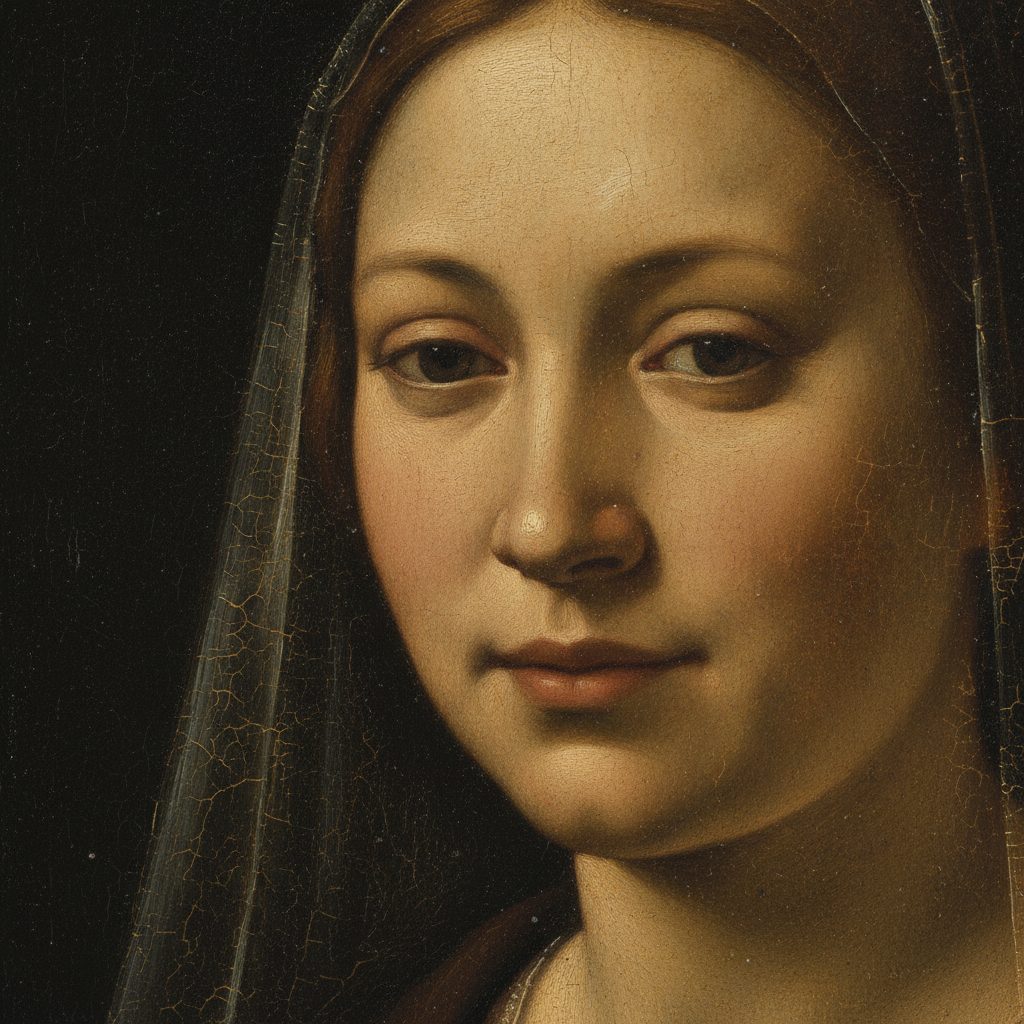
His great technical gift was sfumato — Italian for "gone up in smoke" — the soft, edgeless blending of tone that makes the Mona Lisa's smile seem to shift as you watch. Where earlier painters drew a hard line around a face, Leonardo dissolved it, letting form emerge from shadow the way a real face does in a dim room. He finished very few paintings; he was too busy asking questions. But the handful he completed changed what a picture could be.
Leonardo dissolved the outline; Michelangelo carved it in stone; Raphael made both look effortless.
Michelangelo: the sculptor who painted
Michelangelo Buonarroti (1475–1564) insisted, to the end of his life, that he was a sculptor, not a painter. You can see it in everything he made. His figures have the weight, torsion and muscular grandeur of carved marble, even when they are only pigment on plaster.
When the Pope pressed him to paint the ceiling of the Sistine Chapel, Michelangelo — resentful, working for four years on scaffolding with plaster dripping into his eyes — produced one of the supreme achievements in art: hundreds of figures, each a sculpted body caught in motion, crowned by the outstretched hands of God and Adam almost, but never quite, touching. That fraction of an inch of empty space between two fingertips is one of the most eloquent gaps ever painted. His vision of the human body as heroic, straining and divine set the template for grandeur itself.
Raphael: the master of harmony
Raphael (1483–1520) was the youngest, the most charming, and in his own time the most beloved. He was also the great synthesiser: he studied Leonardo's softness and Michelangelo's power and fused them into something that looks utterly serene, as if it had cost no effort at all.
His fresco The School of Athens gathers the philosophers of antiquity into a single grand hall, each figure perfectly placed, the whole composition balanced like a piece of music — Plato and Aristotle at the vanishing point, the architecture drawing your eye straight to them. Nothing is crowded; nothing is wasted. Raphael made supreme difficulty look like grace, and for centuries art academies taught his balance as the very definition of "correct" composition. He died at just 37, on what is traditionally said to be his own birthday.
Why they still set the standard
It is tempting to file these names under "old and important" and move on. That would be a mistake, because their inheritance is still the water we swim in. When a film lights an actor's face out of shadow, that is Leonardo. When a superhero's body is drawn as heroic muscle in motion, that is Michelangelo. When a photograph feels perfectly, invisibly balanced, that is Raphael's harmony, learned second- or third-hand.
The three masters proved that a picture could carry the full weight of thought, anatomy, emotion and design at once — and make it look inevitable. Every painter since has worked either in their tradition or in deliberate rebellion against it, which is only another kind of debt. To learn to read their work, start with the tools they perfected: the drama of light and shadow, and the wider craft of reading a masterpiece.