Klimt's Portrait of Elisabeth Lederer: The Painting That Helped Save Its Subject
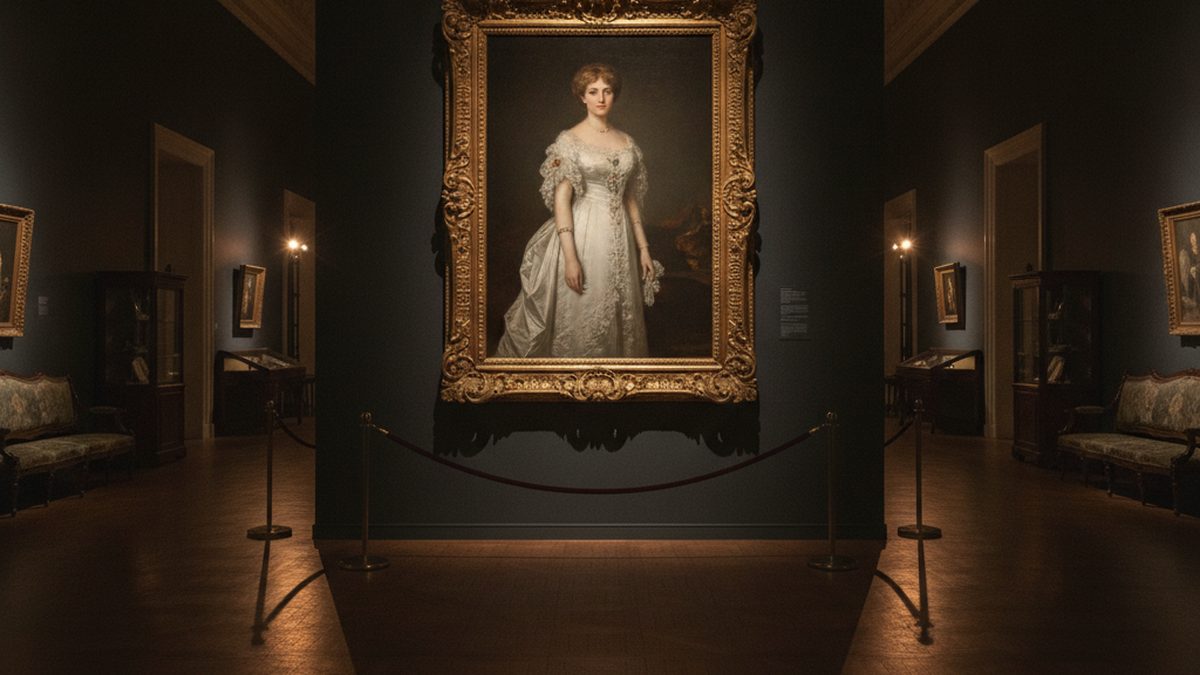
On the evening of 18 November 2025, in the concrete galleries of the old Breuer building on Madison Avenue, an auctioneer's hammer settled a number that will be quoted for a long time. A life-size portrait of a young woman in a Chinese-embroidered robe, painted by Gustav Klimt more than a century earlier, sold for 236.4 million dollars. It was the most expensive work of modern art ever sold at auction, and the second most expensive painting of any era to change hands under the hammer — behind only Leonardo's Salvator Mundi. The bidding had opened at 130 million and ran for some twenty minutes. When it was over, Sotheby's had its highest single-lot sale in a history that stretches back 281 years.
The number is the news. But the number is also the least interesting thing about this painting. Because the young woman looking out of the canvas — pale, composed, faintly amused — spent part of her own life using this very portrait as a shield against a regime that wanted her dead. Her name was Elisabeth Lederer, and hers is one of those stories where art history stops being about brushwork and becomes about survival.
The second wealthiest family in Vienna
To understand the portrait you have to understand the house it hung in. The Lederers were, by the reckoning of the day, the second wealthiest family in Vienna — behind only the Rothschilds. August Lederer had made a fortune in industry; his wife, Serena, poured a good part of it into contemporary art, and in particular into the work of one difficult, brilliant, endlessly scandalous painter. By the turn of the century the Lederers owned the largest private collection of Klimts in the world. Klimt lived nearby and was a frequent visitor; he was, in the fullest sense, the family's artist.
Serena herself had sat for Klimt in 1899. So when he came to paint her daughter Elisabeth between 1914 and 1916, he was not painting a stranger. He was painting a girl he had watched grow up, in a household where he was almost furniture. The result is a portrait of unusual tenderness for Klimt — less armoured than his famous gold-ground society women, the face done with a portraitist's care while the robe dissolves into the shimmering, patterned reverie that was by then his signature. If you want to see where that decorative language came from, our essay on gold in art traces the line from Byzantine gold grounds straight through to Klimt's studio.
An empire, and then a fire
Then came 1938. In March, Nazi Germany annexed Austria in the Anschluss, and for Vienna's Jewish families the world inverted overnight. The Lederer collection — one of the great assemblies of modern painting anywhere — was seized. August had died in 1936; Serena fled to Budapest, where she died in 1943, having lost almost everything she had spent a lifetime gathering.
The bitterest chapter came at the very end of the war. Much of the confiscated Lederer collection had been stored for safekeeping at Schloss Immendorf, a castle in Lower Austria. In May 1945, as the front collapsed, the castle burned — by most accounts set alight by retreating SS troops. Fifteen Klimt paintings were destroyed in that single fire, among them some of his most ambitious work. It remains one of the largest losses of a single artist's output in the twentieth century, a subject we return to in our piece on provenance and the story behind a painting.
The portraits survived for the cruellest of reasons: the regime decided that pictures of Jewish sitters were not worth stealing.
And here is the strange twist that would matter so much to Elisabeth. The family portraits — hers among them — were not sent to the castle, and so did not burn. Nazi cultural bureaucracy had ruled that portraits of Jewish subjects were of no value to the Reich; they were left behind at Vienna's Dorotheum auction house, unwanted. The looters' contempt is the only reason the painting exists to have sold for a quarter of a billion dollars.
A daughter, a portrait, and a lie that held
Elisabeth had married a baron, Wolfgang von Bachofen-Echt, in 1921, converting to Protestantism; after their divorce in 1938 — a divorce that stripped away whatever protection the marriage had offered — she was, in the eyes of the new regime, simply a Jew in Vienna. Deportation was a matter of time.
What she did next reads like fiction, except that it happened. She obtained documentation asserting that her real father was not August Lederer at all, but Gustav Klimt — a Gentile. The claim was not as wild as it sounds to us: Klimt's intimacy with the Lederer household was well known, his reputation with his female sitters was the stuff of Viennese gossip, and here, on the wall, was the evidence — a portrait of extraordinary closeness, painted by a man who clearly knew this young woman well. A former brother-in-law, by then a Nazi official, is said to have helped push the paperwork through. The authorities accepted it. The fiction of an illegitimate Klimt daughter, backed by the painting itself, kept Elisabeth alive in a city that was deporting people like her to their deaths. She died in Vienna in October 1944, of illness rather than in a camp — a survival that was partial, exhausting, and, by the standard of those years, almost miraculous.
There is something vertiginous in it: a decorative society portrait, the kind of thing we are trained to walk past in a museum, turned into a life-or-death document. It is a reminder that the questions we ask of a painting — who is this, who made it, what did it mean to them — are never merely academic. The habit of reading a masterpiece closely is exactly the habit that recovers stories like this one.
From restitution to a New York dining room
After the war the surviving Lederer portraits were restituted. In 1948 the painting was returned to Elisabeth's brother, Erich Lederer, who had escaped to Switzerland and spent decades fighting for the return of his family's property. In 1983 Erich sold the portrait to the dealer Serge Sabarsky, and in 1985 it passed to Leonard Lauder, heir to the Estée Lauder cosmetics fortune and one of the most serious collectors of Austrian and German modernism in the world.
For roughly forty years the portrait hung, quietly, in Lauder's New York home — not in a vault or a bank, but on the wall of a private residence, looked at daily by a man who plainly loved it. Lauder died in June 2025 at the age of 92. The sale five months later was the estate letting go, and the art world's verdict on what the picture had become: not just a Klimt, but one of the small handful of paintings that carry the whole weight of a century's history in their provenance.
What the number really measures
It is easy to be cynical about a 236-million-dollar painting — to see only the spectacle of money, the trophy hunt, the way the very top of the market has detached from anything a normal person would call reason. That cynicism is not wrong, exactly. But it misses what a price like this actually registers. Rarity is part of it: after the Immendorf fire, full-length Klimt portraits of this quality are essentially unbuyable; almost everything comparable is in a museum and will never move. Condition and an unbroken, well-documented chain of ownership are part of it too — the kind of clean provenance that, as we've written before, can matter as much as the brushwork itself.
But the deepest part of the value is the story. Collectors at this level are not only buying an image; they are buying everything the image has survived. This portrait carries the annihilation of a great collection, the burning of fifteen masterpieces, the ingenuity of a woman who used her own likeness to outwit a genocidal state, and forty quiet years on a Manhattan wall. You cannot separate the paint from the history, and at the very top of the market, nobody tries to. The record, in that sense, is honest. It is the price of a painting that refuses to be only a painting.
Elisabeth Lederer never wanted to be a symbol. She was a young woman in an embroidered robe, sitting for the family friend, in a Vienna that thought it would last forever. What survives of her now is a face on a canvas, and a story that outran the men who tried to end it. That, in the end, is the whole art legacy: not the number on the night, but the life the picture kept.
Frequently asked questions
How much did Klimt's Portrait of Elisabeth Lederer sell for? It sold for 236.4 million dollars at Sotheby's in New York on 18 November 2025 — the most expensive modern artwork ever sold at auction, and the second most expensive painting of any kind, behind Leonardo da Vinci's Salvator Mundi.
Who was Elisabeth Lederer? Elisabeth Lederer (1894–1944) was the daughter of August and Serena Lederer, Jewish industrialists and among Klimt's most important patrons. He painted her life-size portrait between 1914 and 1916.
How did the portrait help save her life? After the 1938 Anschluss, Elisabeth obtained false papers claiming that Klimt — a non-Jewish artist — was her real father. The intimacy of the portrait and Klimt's closeness to her family lent the claim credibility, and it helped shield her from deportation until her death from illness in 1944.