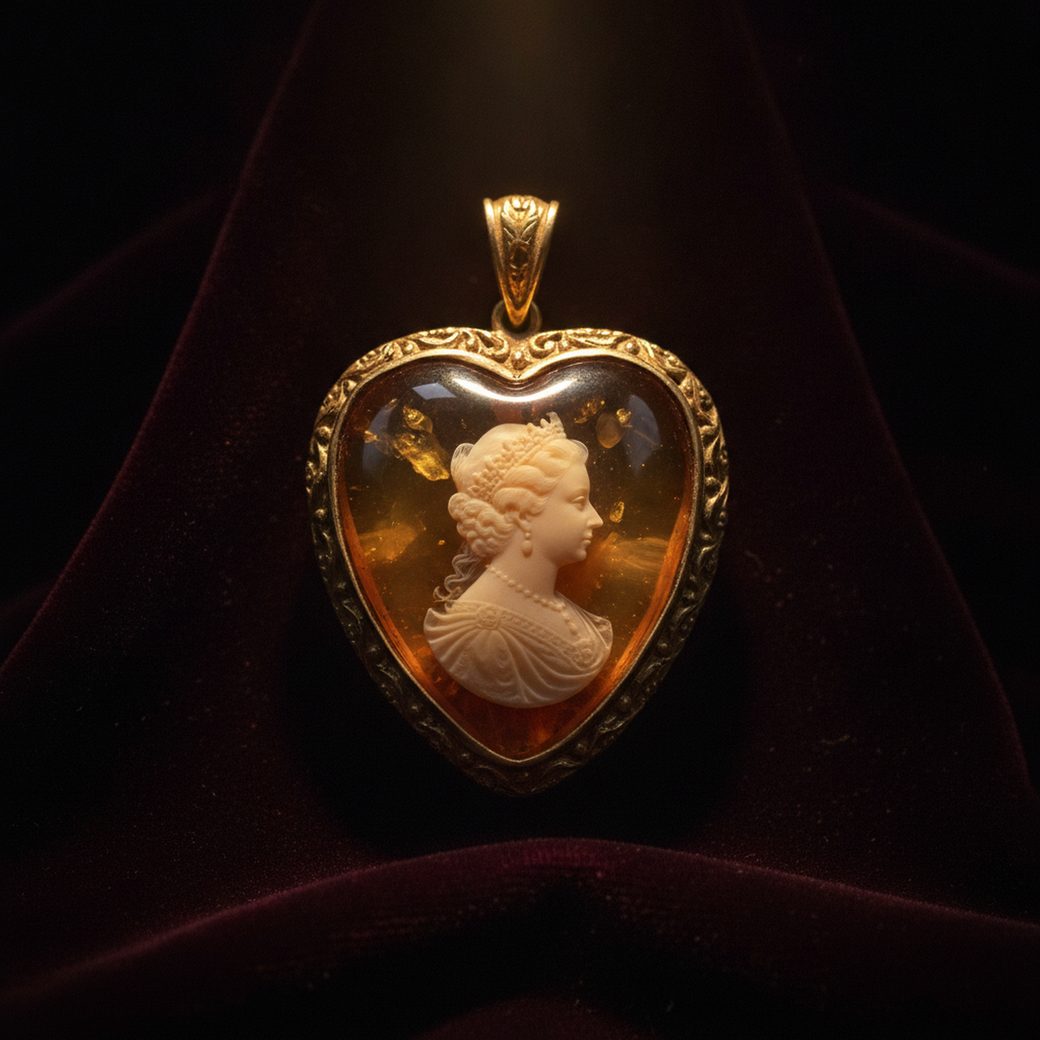
On 12 November 2025, at Lyon & Turnbull's rooms in Edinburgh, a small object came under the hammer and went almost unnoticed. It was a piece of amber, heart-shaped, not much bigger than a coin — 41 millimetres, about an inch and a half — with a faint pale profile carved into it. The catalogue did not shout. It sold for £5,588, a price that says the room saw a pretty old curio and little more. Somewhere in that saleroom, one buyer saw something else entirely.
Eight months later, the same piece of amber was hanging in a very different light. On 1 July 2026, Sotheby's offered it in London in a sale grandly titled Master Sculpture from Four Millennia, now identified as a rediscovered Renaissance jewel: a carved portrait of Queen Elizabeth I, made around 1600, with an estimate of £100,000 to £150,000. In the trade there is a word for an object that does this — that passes through one sale unrecognised and surfaces in the next transformed. It is called a sleeper. This is the story of how one woke up.
What the amber actually is
Held to the light, the pendant reveals its trick. A profile of the queen has been micro-carved as a cameo in a pale, near-white material — likely white amber, or a fine tin-rich compound — and then set into a heart of warm yellow amber cut so that the translucent stone magnifies and lifts the face, as if the portrait were floating inside honey. On the reverse, engraved into the amber, is a parrot. It is a small, deliberate detail: in the emblem-language of the period the parrot stood for chastity and purity, a fitting device for the sovereign who had built a whole political mythology around being the Virgin Queen.
Amber was not a casual material in 1600. It washed up on the Baltic shore, and the trade in it was a jealously guarded monopoly of the Prussian dukes, worked by a guild of master carvers in Königsberg. To carve a royal likeness into amber this finely was court-level work, and scholars now attribute the pendant to one of two names from exactly that world: Hans Klingenberg (active in Königsberg from around 1593) or Georg Schreiber. Which of the two held the tool, we cannot say — the attribution is an either/or, and honesty requires keeping it that way rather than picking the more flattering name.
It sold for £5,588 as a curio. Eight months later it was a rediscovered Renaissance jewel of the Virgin Queen.
An emblem "likely a gift from her own hand"
What lifts the pendant from fine object to historical document is what it may have meant. Portrait jewels of Elizabeth were not ornaments you bought; they were favours the queen gave — worn at court as a visible sign that you stood in her light. The jewellery historian Geoffrey Munn, assessing the amber, called it "an extraordinarily rare emblem" and suggested it was "likely a gift from her own hand." If that is right, this is not a picture of power so much as a physical token of it: a small warm stone that once said, to whoever wore it, the queen knows your name.
That reading has to carry a caveat. "Likely" is an art historian's word doing careful work; there is no receipt, no letter, no inventory line that proves Elizabeth handed this specific heart to a specific courtier. The physical evidence — the royal likeness, the chastity emblem, the court-grade amber-work — makes a gift plausible, even probable. But plausible is not proven, and the difference between those two words is precisely the discipline of reading an object instead of romancing it.
How a royal jewel goes to sleep
The strangest part of a sleeper is not that it is undervalued once. It is that it can hide in plain sight for generations. This amber was not lost in an attic. It belonged to the Victorian collector John Malcolm, 1st Baron Malcolm of Poltalloch (1833–1902), a serious connoisseur, and in 1879 it was thought important enough to be lent to a landmark exhibition at the Burlington Fine Arts Club in London, where it hung as catalogue number 377. Then it descended quietly through the Malcolm family for more than a century — until, in 2025, it reached the saleroom stripped of that history. The 1879 exhibition record and the sixteenth-century dating had simply fallen off the object somewhere along the way.
This is how sleepers are made. Not by forgery or fraud, usually, but by attrition — a label lost, a memory not written down, a great-grandchild who inherits a box of "old things." An auction house at the local level cannot deep-research every lot; the resources are not there, and much of what passes through is genuinely minor. So the burden of knowing falls on the sharpest eye in the room. As specialists in the sleeper trade put it, the successful hunter is "part sleuth, part gambler," betting real money on a work before anyone will confirm the hunch — reading the style, chasing the provenance, and, increasingly, sending the object for scientific analysis to settle what the eye suspects.
The moment of waking
Between that Edinburgh sale and the Sotheby's catalogue, the pendant crossed from curio to masterpiece by the ordinary, unglamorous machinery of scholarship: comparison against the handful of surviving Königsberg ambers, reconstruction of the Malcolm provenance and the 1879 exhibition, and technical study of the material. None of that changed the object by a single gram. What changed was what could be known about it — and in the art market, knowledge is the price. The value did not appear in the amber; it appeared in the attribution.
That is a pattern this journal keeps meeting. It is the same force that let a cleanly documented Rembrandt hide for years under another man's overpaint until infrared lifted the veil, and the same reason a watertight chain of ownership can be worth more than the paint it certifies. Collectors, when they reach deep, are paying for certainty — the very premium that recently drove a copy of an ancient statue, the Hamilton Laocoön, to £13.6 million because nobody could doubt what it was. An amber heart with a royal face and a documented Victorian pedigree offers exactly that: not a maybe, but a known thing.
What we still don't know
It would be neat to end with a triumphant hammer price — the £5,588 curio realising a quarter of a million under the lights. But at the time of writing Sotheby's had not published a public result for the lot, and it would be dishonest to invent one. What is solid is the arc: a 41-millimetre amber of Elizabeth I, exhibited in 1879, forgotten, sold as a trinket for £5,588 in Edinburgh in November 2025, and re-catalogued as a Renaissance royal jewel at £100,000–150,000 eight months later. The maker remains one of two men; the "gift from her own hand" remains a strong likelihood rather than a fact; the final price, for now, remains between Sotheby's and a bidder.
None of those uncertainties diminishes the object. If anything they are the point. A sleeper is a small, hard lesson in humility for everyone who looks at art and thinks they can see everything a thing is worth. The eye that spotted this one in an Edinburgh catalogue was not luckier than the rest of the room — it was better read. It had simply looked more slowly, and known more, than the price on the label. That, in the end, is the whole craft.
Frequently asked questions
What is a sleeper in the art market? A work whose true maker, date or importance is not recognised when it is sold, so it changes hands cheaply — then is reattributed through research and sold again for far more. This amber pendant went from £5,588 in Edinburgh to a £100,000–150,000 estimate at Sotheby's in eight months.
How much did the Elizabeth I amber pendant sell for? It sold for £5,588 at Lyon & Turnbull, Edinburgh, on 12 November 2025, unrecognised as a royal jewel. Sotheby's offered it again in London on 1 July 2026 with a £100,000–150,000 estimate; a hammer result was not public at the time of writing.
Who carved it, and when? Around 1600, by one of two German amber masters working for the Prussian court in Königsberg — Hans Klingenberg or Georg Schreiber. The heart-shaped yellow amber holds a pale cameo of Elizabeth I, with a parrot, an emblem of chastity, engraved on the reverse.