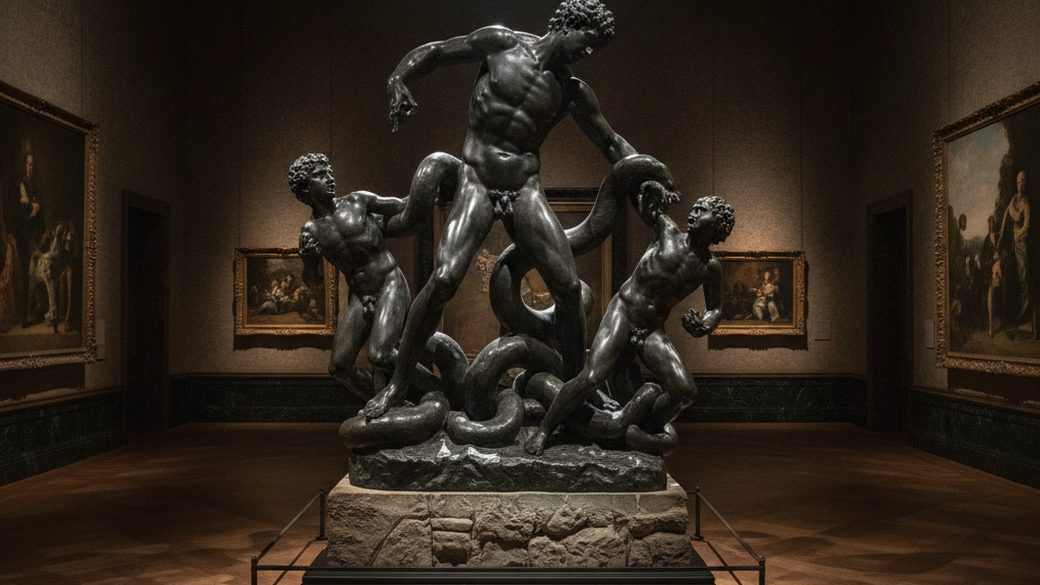
On the evening of 1 July 2026, in a saleroom on New Bond Street, the story that everyone had come to watch was a lost early Rembrandt. It sold, quietly, on a single bid for £8 million — the bottom of its estimate. The picture that actually detonated the room was not a painting at all, and not, strictly speaking, an original. It was a bronze. A copy. A nineteenth-century reproduction of a statue that had already been famous for two thousand years.
The Hamilton Laocoön carried a modest estimate of £2–3 million. Over roughly fifteen minutes, at least four bidders on the telephones fought it upward in a duel that ended at £13.6 million with fees — about $18.1 million, and nearly seven times the low estimate. It was, at a stroke, the most valuable Neoclassical sculpture ever sold at auction. To understand why a copy did that, you have to go back to the thing it copied — and to the January morning, five hundred years ago, when it climbed out of the Roman ground.
The statue that a Roman dug out of his vineyard
On 14 January 1506, a landowner named Felice de Fredis was digging on the Esquiline Hill in Rome, near the ruins of the Baths of Trajan, when his workmen struck marble. What they pulled from the earth was a single, violent, unforgettable group: a bearded priest and his two sons, their bodies torqued in agony, crushed in the coils of two enormous sea serpents.
Word reached the Vatican within hours. Pope Julius II sent his architect Giuliano da Sangallo to look, and Sangallo brought along a friend who happened to be in Rome — the young Michelangelo. According to Sangallo's son, the moment his father saw the tangle of limbs and serpents emerge, he said at once: "That is the Laocoön, which Pliny mentions." He was quoting from memory. The Roman writer Pliny the Elder, in his Natural History, had praised a Laocoön group in the palace of the emperor Titus as "a work to be preferred to all others, whether in painting or in sculpture," and had named its makers as three sculptors from Rhodes: Hagesander, Polydorus and Athenodorus.
To identify a statue the instant it left the ground, from a book written fifteen centuries earlier, is one of the great party tricks of the Renaissance — and a reminder that these men had read their classical sources so closely that the ancient world was, for them, a living memory. Pope Julius bought the group within weeks and installed it in the Belvedere courtyard of the Vatican, where a version of it still stands. It has never really left.
Sangallo named it the moment it left the earth. He was quoting a Roman who had died fourteen hundred years before.
Why a broken statue became the most influential in the West
The subject is a horror story from the fall of Troy. Laocoön was a Trojan priest who warned his city not to drag the Greeks' wooden horse inside the walls — "I fear the Greeks, even bearing gifts." For this, in the version Virgil tells in the Aeneid, the gods who wanted Troy to fall sent two serpents from the sea to strangle him and his sons before the crowd. The statue freezes the instant of divine punishment: not the clean heroism of most classical sculpture, but pain — muscles knotted, a mouth open in a cry, a father unable to save his children or himself.
That raw physical anguish is exactly why the Laocoön hit the Renaissance like a thunderclap. Michelangelo called it a "singular miracle of art," and you can see its writhing, muscular bodies echo through his own work and the century of sculpture that followed. It became the benchmark against which sculptors measured themselves — the reason the generation of Leonardo, Michelangelo and Raphael is unthinkable without the antique models they were unearthing at exactly this moment. Two and a half centuries later the German critic Gotthold Lessing would use the statue as the centrepiece of an entire theory of art, arguing over how — and whether — sculpture should show a scream.
The mystery of the missing arm
The group came out of the ground incomplete. Most conspicuously, the priest's right arm was missing, and for four hundred years nobody knew how it had been posed. In 1510 an informal contest was held to settle it, with Raphael as judge. The sculptor Jacopo Sansovino won with a heroic, outstretched arm, flung dramatically upward — and for centuries the Laocoön was completed and copied that way, arm reaching to the sky.
Michelangelo dissented. He argued the arm should bend back, toward the shoulder, folding in on the body rather than reaching out of it — a more anguished, more inward gesture. He was overruled, and the theatrical straight arm won the day. Then, in 1905, the archaeologist Ludwig Pollak spotted a fragment of a bent marble arm in a Roman builder's yard, near where the statue had been found. Half a century later, conservators established that its drill-hole matched the shoulder exactly. The arm was Laocoön's. It bent backward — just as Michelangelo had insisted four hundred years before. The Vatican quietly removed the plaster arm and restored the real one.
It is a story almost too neat, and it deserves a note of honesty: whether Michelangelo reasoned his way to the correct pose or simply guessed well is not something we can prove, and the "Michelangelo was right all along" version has been polished over the centuries into legend. What is solid is the archaeology — the found arm, the matching drill-hole, the corrected statue. The rest is a good story built, carefully, on a true one. Sorting the fact from the flourish is the whole discipline of reading a masterpiece honestly.
How you copied a masterpiece before photography
Here is the thing modern eyes forget: for almost all of the statue's afterlife, hardly anyone who admired the Laocoön had actually seen it. It sat in the Vatican. If you were a British aristocrat on the Grand Tour, or a French academy training its sculptors, you knew the Laocoön through copies — plaster casts taken from moulds pressed against the marble, and bronzes cast in turn from those.
A full-size cast was a serious undertaking and a serious statement. To own one was to bring the single most prestigious object in Western art history into your own hall. That is what the wealthy collector George Watson Taylor set out to do when, around 1817, he commissioned the French sculptor Auguste-Jean-Marie Carbonneaux to sandcast a full-size bronze from a 1797 plaster mould of the Vatican marble. It is one of only four full-size bronze casts of the Laocoön known to have been made by the early nineteenth century — its siblings now in the French Parliament and at Houghton Hall in Norfolk.
Watson Taylor's timing was poor; he overreached financially and sold the bronze in 1821. From there it entered one of the most glittering ownership chains in British collecting — passing through the novelist and legendary aesthete William Beckford, the Duke of Buckingham and Chandos, and finally the Dukes of Hamilton, whose name it now carries. It stood at Hamilton Palace, and then, for a very long time, it stood mostly out of public sight — which is why its explosive reappearance at auction took the market by surprise.
Why the copy beat the original in the room
Return, now, to that saleroom on 1 July. A rediscovered early Rembrandt — an actual, if complicated, work by one of the greatest painters who ever lived — sold flat, on a single bid, for £8 million. A bronze reproduction of an ancient statue sold for £13.6 million after a fifteen-minute fight. On the face of it, that is absurd. The market appeared to value a copy above an original.
But look closer and the logic is not absurd at all; it is the logic of provenance. The Rembrandt came with baggage: a later hand had finished it, its condition was complicated, and scholars were still arguing over exactly how much of it was his — you can read that strange tale in our piece on the Rembrandt rediscovered under another man's brush. The bronze came with none of that doubt. Nobody disputes what it is, who cast it, or whose halls it has passed through. It is a flawless object with a spotless, star-studded pedigree and only three siblings on earth. Collectors, when they reach for their deepest reserves, are very often paying for certainty — the same premium that pushed a cleanly-provenanced Klimt portrait to $236 million a few months earlier — and the same appetite that, days later at Christie's, drove a pair of Jan van Huysum flower still lifes to record prices.
And there is something older at work here too. When those four bidders drove the Hamilton Laocoön to nearly seven times its estimate, they were not really bidding on an 1817 bronze. They were bidding on a chain that runs back through Hamilton Palace and the Grand Tour, through Michelangelo kneeling at the edge of a Roman pit, all the way to three sculptors from Rhodes and a priest who was punished for telling the truth. The bronze is a copy. But what it copies has never stopped being the most valuable idea in Western sculpture — and on that July evening, for fifteen minutes, the room agreed to pay for it.
Frequently asked questions
How much did the bronze Laocoön sell for? The Hamilton Laocoön sold at Sotheby's in London on 1 July 2026 for £13.6 million (about $18.1 million) with fees, against a £2–3 million estimate — a record for a Neoclassical sculpture at auction.
Is it a copy of the ancient Laocoön? Yes. It is a full-size bronze cast made in 1817 by Auguste-Jean-Marie Carbonneaux, taken from a plaster mould of the ancient marble Laocoön group that was unearthed in Rome in 1506 and still stands in the Vatican. Only four such full-size bronzes are known.
Why is it called the Hamilton Laocoön? It is named for the Dukes of Hamilton, who long owned it. Before Hamilton Palace it belonged to the collector George Watson Taylor, the novelist William Beckford and the Duke of Buckingham and Chandos — a famous chain of ownership that helped drive the price.