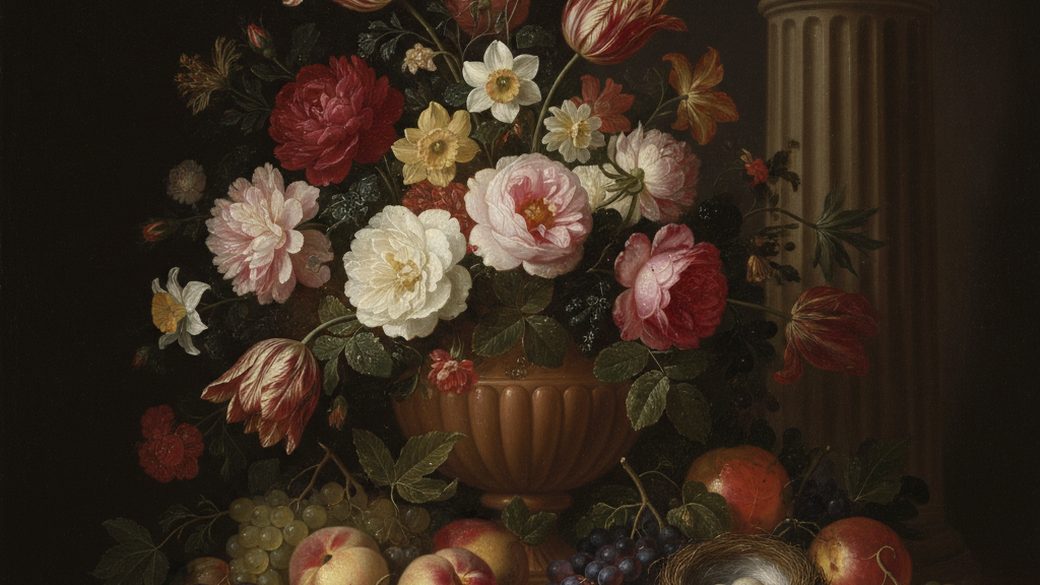
On a July evening in a saleroom off St James's, the picture that won the night was not a saint, not a duke, not a battle. It was a heap of fruit. Peaches and grapes, plums and raspberries, currants and a split melon, a scatter of hazelnuts and a few loose flowers, all tumbled before a stone column and a terracotta urn. It was painted three hundred years ago by a man who grew his own flowers, locked his studio door against his own brothers, and would keep a half-finished canvas waiting a full year for a single rose. When the hammer fell, Jan van Huysum's pile of fruit had sold for £6.52 million — about $8.65 million — and set a new record for the artist.
Its companion, an equally lavish bouquet — roses, peonies, narcissi and poppies erupting from a sculpted terracotta vase, a bird's nest tucked at its foot — followed close behind at £5.54 million (about $7.35 million). Two records in one night, for a painter of flowers. To understand why the market reached that deep for a still life, you have to understand the strange, obsessive, secretive man who made them, and the vanished world that once ranked him above almost everyone.
The most expensive flowers in the Dutch Republic
Jan van Huysum was born in Amsterdam in 1682, into a family of painters. His father, Justus, ran a busy workshop; three of Jan's brothers painted too. But Jan outgrew them all, and by the height of his career he was the most sought-after flower painter alive, working for a clientele that stretched far beyond the Dutch Republic — collectors in Germany, France, Poland and England competed for his output, and he could name prices no earlier flower painter had dared.
The numbers, even in his own lifetime, were startling. A single van Huysum could cost several times what a picture by an earlier master fetched — the sort of premium that today sounds like auction-house hyperbole but was, in the 1720s and 1730s, simply the going rate for the best flower painter in Europe. He had turned a genre that hung in the kitchens and back parlours of merchant houses into something a prince would pay a fortune to own.
He painted flowers. He was, for a while, worth more per canvas than almost any painter of anything in Europe.
The impossible bouquet
Here is the first secret hiding in plain sight in a van Huysum: the bouquet in front of you never existed. It could not have. In the great vase you will find a spring tulip beside a summer rose beside an autumn anemone — flowers that bloom months apart, gathered into one impossible arrangement that no gardener could ever have cut on a single morning.
Van Huysum built these bouquets the slow way. He grew specimen plants in his own garden for close study, and he painted from life — fresh-cut blooms, examined one at a time — rather than from imagination or from other men's prints. When a picture needed a particular flower that was out of season, he simply stopped and waited. One celebrated account has him telling a patron that a canvas could not be finished until the following year, because he needed a specific yellow rose that would not bloom until then. The painting was not late. It was waiting for the garden.
That patience is why his surfaces feel so uncannily alive. Every petal is observed at its own moment of perfection, then composed into a whole that pulls the eye in slow, circular sweeps around the vase. Look closely and the illusion deepens: a bead of dew trembling on a leaf, an ant crawling across a petal, a caterpillar, a bird's nest with pale speckled eggs, a snail leaving its wet trail along the ledge. These are not decoration. They are the painter quietly reminding you that all this beauty is cut, and cut things die — the old moral of the Dutch still life, that abundance and decay are the same picture seen at two different hours.
The locked studio
The second secret van Huysum kept was literal, and he kept it behind a bolted door. He was famously, almost pathologically, protective of his technique. He is said to have refused to let anyone into his studio while he worked — not students, not rivals, not even his own painter-brothers — for fear that they would learn how he purified his pigments and laid on his colours.
What he was guarding was a method of extraordinary refinement: layer upon layer of thin, translucent oil glazes, built up so patiently that the finished surface seems lit from within, the enamel-smooth petals almost dissolving the brushmark entirely. Contemporaries tried to copy it and could not. He took, in effect, almost no pupils and left almost no school — a near-unheard-of choice in an age when a successful master's workshop was his pension, his brand and his legacy. Van Huysum chose secrecy over succession, and so his method largely died with him in 1749.
It is worth being honest about how much of this we can prove. Much of the van Huysum legend — the locked door, the year-long wait for a rose, the brothers turned away — comes down to us through early biographers and dealers who had every reason to burnish the myth of the untouchable genius, because myth is what sells pictures. The core is solid: the technical brilliance is in the paintings themselves, the seasonal impossibility of the bouquets is a matter of botany, and the scarcity of imitators is real. The flourishes around them are the sort of story that grows on a great reputation. Telling the fact from the flourish is, as ever, the whole discipline of reading a picture and its history honestly.
Why flowers, and why then
To a modern eye a bowl of fruit can look like the lowest rung of art — a thing you paint when you cannot paint people. The Dutch Golden Age did not see it that way, but it did rank it that way. In the academic hierarchy of genres, history painting and portraiture sat at the top; still life sat near the bottom, a test of skill more than of imagination. Van Huysum's achievement was to take the humblest genre and paint it so supremely well that the hierarchy briefly stopped mattering. A prince who would never have hung a still life in his state rooms wanted this one.
He worked at the very end of the golden century, when the great age of Dutch painting was already closing. Rembrandt had been dead since 1669; the Republic's confidence was cooling. Van Huysum is, in a sense, its late, hothouse flower — the tradition of light and shadow perfected by earlier masters, refined here to an almost artificial sweetness, brilliance pushed to the edge of excess. He is the sunset of the Dutch Golden Age, and he glows accordingly.
Why the record, and why now
So why did two of his canvases break his record on the same July night in 2026? Part of the answer is simply that great van Huysums almost never come to market; when a pair surfaces in fine condition and with a clean history, the competition is fierce, and estimates of £3–4 million get left far behind.
But the larger answer is a shift in the market itself. Old Masters, long the quiet cousin of the contemporary saleroom, are drawing a new wave of buyers — and a fresh appetite for discovery is fuelling them. Across the same run of London sales, six artist records fell in a single evening; Christie's and Sotheby's together turned over more than $100 million in Old Masters, up roughly a tenth on the year before. It is the same current that pushed a rediscovered early Rembrandt into the salerooms and drove a bronze copy of the ancient Laocoön to £13.6 million that very week. Collectors are paying, above all, for certainty and for rarity — and a first-rank van Huysum, unrepeatable and unteachable, is about as rare as the category gets.
There is a quiet justice in it. Van Huysum spent his life making the fleeting look permanent — freezing flowers that had already wilted, gathering seasons that never met, painting decay so beautifully that it read as abundance. Three centuries later, in a room full of people who had come to watch dukes and saints, it was his cut flowers that would not fade. They took the night. The garden, in the end, waited for him too.
Frequently asked questions
How much did the Jan van Huysum still life sell for? His still life of peaches and grapes sold for £6.52 million (about $8.65 million) with fees at Christie's in London in early July 2026, against a £3–4 million estimate — a record for the artist. Its companion floral bouquet made £5.54 million (about $7.35 million).
Why are van Huysum's paintings so valuable? He was the most celebrated flower painter of the Dutch Golden Age, worked in exceptionally fine translucent glazes, took months or years over a single canvas, and guarded his technique so closely that no one could copy it. First-rank examples are extremely rare.
Did he paint real bouquets? No. He painted fresh-cut flowers one at a time and assembled blooms from different seasons into a single impossible arrangement — sometimes waiting a year for a particular flower to come back into bloom.