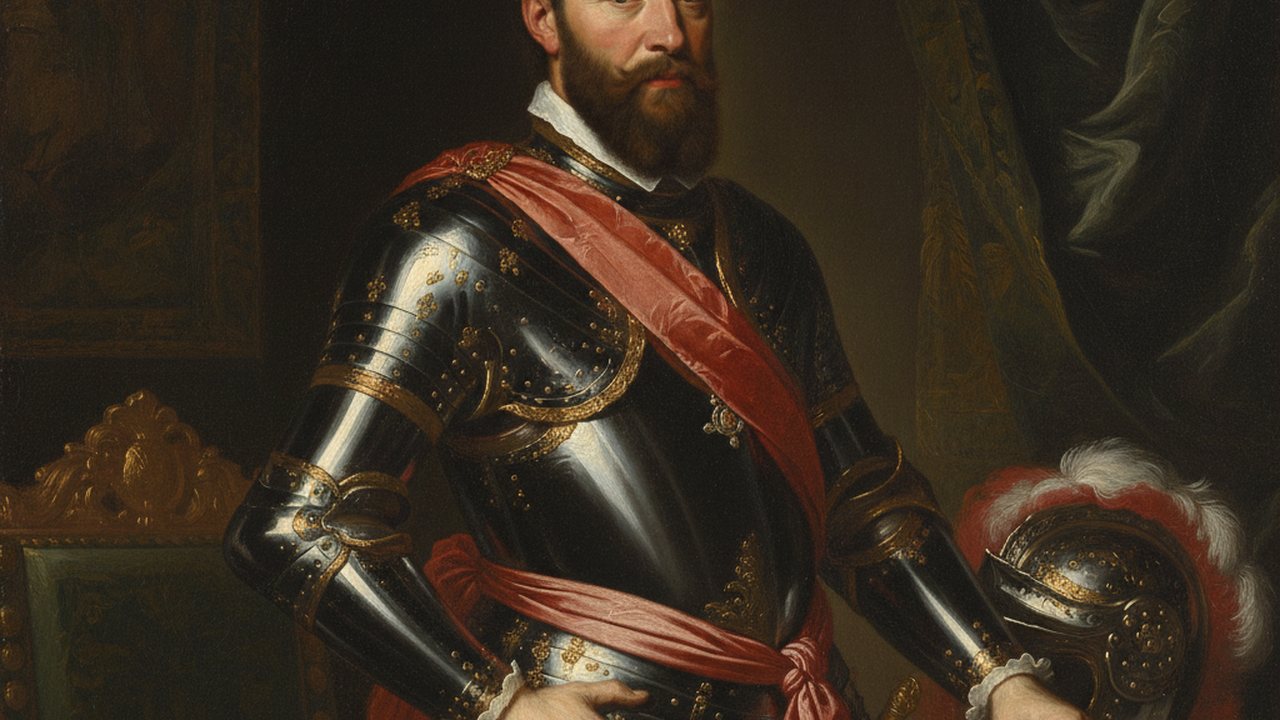
Some paintings are lost the way a coin is lost — dropped, forgotten, gone. Others are lost the way a name is lost: the object survives, hangs on a wall, changes hands, but nobody remembers whose hand made it. For nearly four hundred years, a portrait of one of the most powerful men in Europe was lost in that second, quieter way. It existed. It simply had no author. In July 2026, it got one back — and the author's name was Diego Velázquez.
The man who returned it is Salvador Salort-Pons, director of the Detroit Institute of Arts and, long before that, a specialist in Velázquez. He did not stumble on the picture in an attic. He had been looking for it, on and off, for the better part of twenty years — and when it finally surfaced, it arrived not in a saleroom but in an email, from a restorer in Madrid who was quietly cleaning a canvas nobody had yet dared to name.
The favourite who made a painter
To understand why this particular rediscovery matters, you have to understand the sitter. Gaspar de Guzmán, Count-Duke of Olivares (1587–1645), was not merely a nobleman. For two decades he was the valido of King Philip IV — the royal favourite, the chief minister, the man who actually ran Habsburg Spain while the young king hunted and collected. Olivares was ambitious, restless, and possessed of an unusual instinct: he could spot talent, and he was willing to gamble on it.
In 1623, that instinct fell on a twenty-four-year-old painter from Seville. Olivares, a fellow Sevillian, summoned Velázquez to Madrid, arranged for him to portray the king, and — when the portrait landed — saw to it that the young man was made a court painter on the spot. Everything Velázquez became, from the shimmering Las Meninas to the grave equestrian kings of the Prado, grew from that single act of patronage. If you want the person who set the whole edifice in motion, it is this heavy-lidded, driven man in his armour. Which is exactly why a portrait of him, from the very start of the partnership, is worth two decades of one scholar's attention.
Olivares gambled a court appointment on a twenty-four-year-old from Seville. The portrait is the gambler's own face, painted by the bet that paid off.
A gift that vanished into Rome
The picture was painted around 1626, and it was never meant to hang in Spain. In that year Cardinal Francesco Barberini — nephew of Pope Urban VIII, and one of the great collectors of Baroque Rome — came to Madrid on a diplomatic mission. Olivares, working the levers of soft power, commissioned Velázquez to make portraits tied to the visit, and The Count-Duke of Olivares in Armour was despatched to Italy as a gift, a way of pressing the minister's own image into the memory of the Barberini circle.
It worked, in the short term. The painting duly appears in a Barberini inventory in Rome. And then, as so many objects do once they slip out of the households that commissioned them, it went dark. Inventories stop mentioning it. It is sold, or gifted, or inherited, and each time it moves the label grows fainter, until the day arrives when the canvas is simply "a portrait of a gentleman," Spanish school, hand unknown. The single most valuable fact about a painting — who made it — is also the easiest one to lose, and once it is gone, recovering it is the painstaking discipline we have described as reading a masterpiece: working backward from the object to the truth.
The paper trail and the twenty-year hunt
The first thread back to the surface was pulled not in 1626 but in 1970, when a scholar published extracts from the diary of a seventeenth-century papal diplomat. Buried in those pages was a reference to Velázquez's portrait of Olivares — proof, in ink, that such a painting had once existed and travelled to Rome. For most people that footnote would have been a curiosity. For Salort-Pons, coming to it in the early 2000s, it was a map with the treasure removed. He knew the painting was real. He simply had no idea where it was.
So he did what this kind of detective work actually requires, which is patience without any guarantee of reward. He kept the name in the back of his mind through a whole career; he planned, in 2024, a Detroit exhibition on Velázquez's earliest court years partly as a way of keeping the question alive. And then, at the very end of 2025, the email came: a canvas answering the description was in a restoration studio in Madrid, its old varnish coming off under a conservator's swab. The lost portrait had been in a private collection the whole time, hiding behind its own anonymity.
How you prove a Velázquez
A likeness and a hopeful hunch prove nothing; the history of art is littered with wishful attributions. What turns a "portrait of a gentleman" into a Velázquez is evidence, and here it was largely technical. Conservators and the museum ran the canvas through X-ray, ultraviolet and infrared imaging — the standard battery that lets you see beneath the surface, into the underdrawing and the layered history of a picture.
Three things lined up. First, the pigments matched the specific palette Velázquez was using in the 1620s — what Salort-Pons has called a "perfect match" to the materials of the period. Second, the thread count of the canvas corresponded to that of other securely attributed Velázquez works, including his portraits of Philip IV from 1626–28; painters of the era often cut their canvases from the same bolt of cloth, so a matching weave is a quiet, powerful fingerprint. Third, the underdrawing showed the kind of on-the-canvas revisions — a shifted contour here, a reworked passage there — that are typical of Velázquez feeling his way through a composition rather than a later copyist tracing a finished one. Salort-Pons laid out the case in ARS Magazine, a journal associated with the Museo del Prado — the closest thing Velázquez studies has to a home court.
Honesty requires a caveat, and it is the same one that shadows every discovery of this kind. A first attribution is an argument, not a verdict. It opens a scholarly conversation that can run for years, and other Velázquez specialists will now test the claim, quarrel with it, and either harden it into consensus or chip at it. The evidence here is strong and the scholar is serious; that is a good position, not a closed case. As the Indiana University scholar Giles Knox put it, the find is "a big deal" precisely because it illuminates a moment when the young painter was still fighting for his place — "the old-guard painters hated him." Sorting what we know from what we would like to be true is the whole ethic of the enterprise, the same discipline that governs how a serious collector weighs provenance before parting with a fortune.
Why a rediscovery is worth more than a record
It is tempting to reach, at this point, for a number — to ask what the painting is "worth" now that it wears the right name. But this is not, yet, a market story, and that is part of what makes it a good one. There is no gavel, no telephone bidding war, no headline figure. The value here is of a different kind. A face that had been erased from the record for four centuries — the face, no less, of the man who invented Velázquez's career — has been handed back to history, with the evidence to support it.
That is a rarer event than a price. Auction records come and go with the season; a genuine attribution, if it holds, is permanent. It changes the catalogue of one of the supreme painters in Western art, and it fills in a missing early beat in his story. The art world has had a strange run of these recoveries lately — think of the early Rembrandt that surfaced from under a later hand's overpaint and sold at Sotheby's the same summer, another picture whose real subject had been quietly buried and had to be excavated, or the full-size Constable study for The Cornfield that hung for fifty years in a Texas museum, miscatalogued as a copy. What links them is not money. It is the stubborn fact that a great painting is hard to kill. You can lose its name, sell it as a stranger's work, let it drift through four centuries of indifferent walls — and still, one patient specialist and a bank of imaging equipment can call it back.
When Velázquez and Olivares: Early Years at Court opens in Detroit in January 2027, visitors will stand in front of a man in gold-trimmed armour and a crimson sash and, if the scholarship holds, look into the eyes of the person who changed the course of Spanish painting — restored to us not by luck, but by someone who refused to stop looking for a painting that everyone else had agreed was gone.
Frequently asked questions
Who discovered the lost Velázquez portrait of Olivares? Salvador Salort-Pons, director of the Detroit Institute of Arts and a Velázquez scholar, made the attribution after roughly two decades of searching. The painting surfaced at the end of 2025 in a Madrid restoration studio, and he published his findings in July 2026 in ARS Magazine, associated with the Museo del Prado.
Who was the Count-Duke of Olivares? Gaspar de Guzmán, Count-Duke of Olivares (1587–1645), was the valido — the favourite and chief minister — of King Philip IV of Spain from 1623 to 1643. He brought the young Velázquez from Seville to the Madrid court in 1623 and effectively launched his career.
Is the attribution certain, and where can I see the painting? The case rests on X-ray, ultraviolet and infrared analysis matching the pigments and canvas thread count to other 1620s Velázquez works, plus documentary evidence. Scholars consider it strong, but a first attribution is the start of a debate, not the end. The painting is set to go on view in Velázquez and Olivares: Early Years at Court at the Detroit Institute of Arts from January 2027.