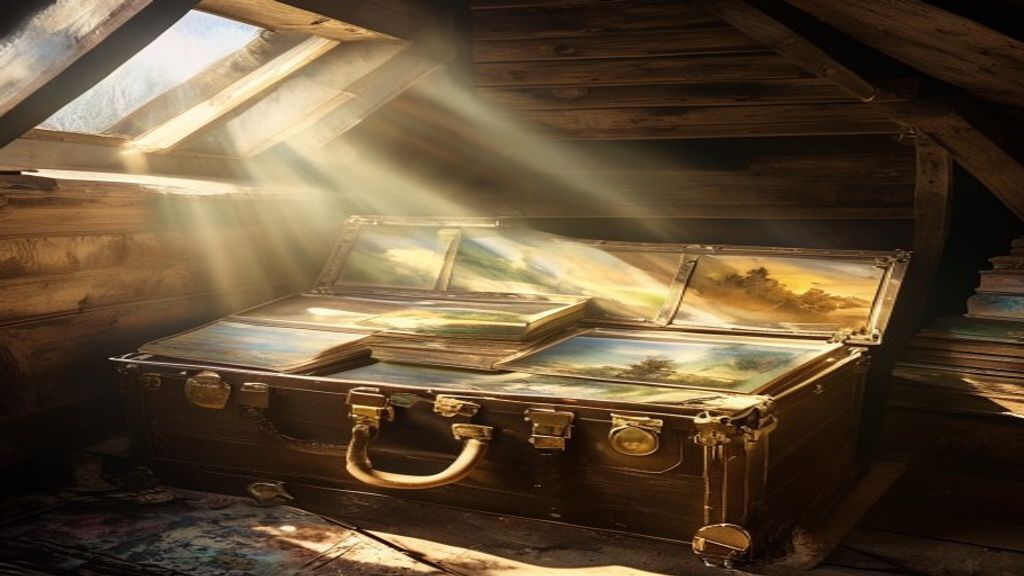
Some paintings are lost to a fire, a war, a careless overpainting. The watercolours of Emily Sargent were lost to something quieter and, in its way, more poignant: a lifetime of not being asked to see them. She painted for more than fifty years — hill towns in Spain, gardens in the Alps, the light on North African walls — and in all that time she never mounted an exhibition, never sold a sheet, never seems to have thought of herself, out loud, as an artist with a public. When she died in 1936 the work went into a trunk. It stayed there, more or less, for the next sixty-two years.
Then, in 1998, a family descendant opened the trunk and found roughly 440 watercolours — a complete, hidden career, intact. In 2026 the story reached its latest turn: a group of these pictures, gathered as the Jemima Pitman Collection, came to auction at Dreweatts in England, the market at last putting a number on a body of work that had spent a century entirely outside it. It is the kind of rediscovery that rearranges a family portrait — and, slowly, an art-historical one.
The other Sargent
To understand why she disappeared, you have to sit beside the person she spent her life beside. John Singer Sargent (1856–1925) was the most sought-after portraitist of the Gilded Age, the painter of Madame X and of half the drawing rooms of London and Boston. His younger sister Emily, born in 1857, was his closest lifelong companion — the two shared homes, holidays and the same restless cosmopolitan childhood, shuttled around Europe by expatriate American parents who never quite settled anywhere.
Emily was not a hobbyist trailing after a genius. She trained, she worked seriously, and by every account she had a real and independent eye. But she carried, from girlhood, a spinal condition that left her in lasting discomfort, and she lived inside the assumptions of her class and her century — assumptions that let a gentlewoman paint beautifully in private while quietly ruling out the ambition of a professional career. Where her brother turned his facility into fame, Emily turned hers inward. The result is a body of work made, as far as we can tell, for no one but herself — which is exactly what gives it its peculiar honesty.
She exhibited nothing in her lifetime. What survives is a private conversation with the light of a dozen countries, never meant to be overheard.
What she actually painted
The watercolours are travel made visible. Emily and John moved constantly — the Alps, Italy, Spain, the Middle East, North Africa — and where he often set up to capture figures and society, she gravitated to place: a whitewashed street collapsing into shadow, the geometry of a Venetian façade, mountains dissolving into weather. Watercolour suited that impulse perfectly. It is the medium of the quick decision and the honest accident, unforgiving of overwork, and it rewards precisely the kind of unhurried, unbossed looking that a painter with nothing to prove and no client to please can afford.
There is a family resemblance to her brother's own celebrated watercolours — the same appetite for dappled Mediterranean light, the same confidence with a loaded brush — but the temperament is her own: cooler, more architectural, less interested in dazzle than in getting the structure of a scene honestly down. Reading them is an exercise in the same attentiveness we describe in how to read a masterpiece: not asking who is depicted, but watching how a hand decided, in a few wet minutes, what mattered in front of it.
Sixty-two years in the dark
The most affecting part of the story is the gap. When Emily died in 1936, her pictures were not sold or catalogued or fought over; they were simply kept, folded into the estate and, eventually, into a trunk that travelled down the generations as family things do — moved, stored, half-forgotten. For decades the watercolours existed in the most literal sense and in no other: they were real, and unseen, and unknown even to most of the people who might have cared.
That is its own species of loss, and a common one. A picture does not have to be destroyed to vanish from the record; it only has to be unlooked-at. It is the same silence that swallowed a signed early portrait by Sofonisba Anguissola for a hundred years, and that for so long kept a serious woman painter of the nineteenth century like Berthe Morisot filed as an appendage to the men around her. Emily Sargent's trunk is that silence made into an object you could put your hands on.
The trunk opens
The reversal came in 1998, when a descendant opened it. What tumbled out was not a stray sketch or two but the whole enterprise — some 440 finished watercolours, a career's worth of looking that no scholar had ever assessed. The person who did more than anyone to make sense of it was Richard Ormond, the doyen of Sargent studies, himself a descendant of the family and the co-author of the vast catalogue raisonné of John Singer Sargent's work. He and other specialists began the patient business of sorting, dating and placing the pictures.
What followed was, to the family's great credit, less a fire sale than a rescue. Over the following years more than a third of the trove was given to museums rather than sold — the Museum of Fine Arts, Boston, the Metropolitan Museum of Art and Brooklyn Museum in New York, the National Gallery of Art in Washington, Tate in London, the Ashmolean at Oxford and the Sargent House Museum in Gloucester, Massachusetts, among them. In 2025 the Met devoted a focused exhibition, Emily Sargent: Portrait of a Family, to these rediscovered sheets; the Cape Ann Museum had already given her a first showcase in 2022. A painter who never once hung her work in public entered nearly a dozen of the world's great collections in the space of a generation.
The 2026 auction — and an honest caveat
The most recent chapter is a market one. On 7 July 2026 the English auction house Dreweatts presented The Legacy of John Singer and Emily Sargent: The Jemima Pitman Collection, drawn from the holdings of Pitman, a great-niece of the siblings, and timed alongside a lecture on Emily's life and work by the Sargent scholar Elaine Kilmurray. Among the lots were watercolours by Emily herself — the private work finally assigned a public price. The way an estate becomes a saleroom lot, and why the paper trail matters as much as the paint, is the whole subject of collecting and provenance.
Here honesty is owed on two fronts. The first is authorship, and on that there is little drama: these are documented family works, kept together, studied by the family's own scholars, with a provenance about as clean as provenance gets. The second is judgement, and it is more open. It is tempting, in the rush of a rediscovery, to overcorrect — to promote Emily from footnote straight to neglected master. The soberer view is that she was a genuinely gifted amateur in the exact, non-pejorative sense: a painter of real quality who worked outside the professional world entirely. That does not diminish the find. It sharpens it. The point of the trunk is not that a second Sargent was hiding in it, but that a whole category of serious art — made by women, kept private, never marketed — has been systematically underweighted, and here, for once, is 440 sheets of evidence.
Why the trunk matters more than the prices
It would be easy to read this as another lucky attic story with an auction attached. But the hammer prices are the least of it. What the Sargent trunk really recovered is a way of accounting for a life in art that leaves no professional trace — no exhibitions, no sales ledgers, no reviews — and therefore, by the usual measures, no history. Emily Sargent kept faith with her own looking for half a century without a single external reward for it. The trunk was not a hiding place so much as a vote of confidence: work worth keeping, whether or not anyone ever came.
Someone finally did. And the belated arrival of her watercolours in the museums that ignored her contemporaries, and now in the saleroom, is less a discovery than an apology — the record correcting itself, one sheet of paper at a time. A woman travelled the world with a brush and a box of colours, set down what she saw with no expectation of applause, and folded it all away. It took sixty-two years and a family curious enough to open a trunk for the rest of us to be let in.
Frequently asked questions
Who was Emily Sargent? A British-American watercolourist (1857–1936) and the younger sister of the portrait painter John Singer Sargent. She trained seriously and painted landscapes throughout a life of near-constant travel, but never exhibited or sold her work.
How were Emily Sargent's watercolours rediscovered? In 1998 a family descendant opened a long-untouched trunk and found around 440 of her watercolours. More than a third have since been donated to major museums, and a group came to auction at Dreweatts in 2026 as part of the Jemima Pitman Collection.
Where can you see her paintings now? In collections including the Museum of Fine Arts, Boston; the Met and Brooklyn Museum, New York; the National Gallery of Art, Washington; Tate, London; the Ashmolean, Oxford; and the Sargent House Museum in Gloucester, Massachusetts.